
Home Energy
Things to Consider Before Buying an AC in Pakistan
A practical AC buying guide for Pakistani homes covering split, window and inverter models, room sizing, electricity costs, wiring safety and warranty support.
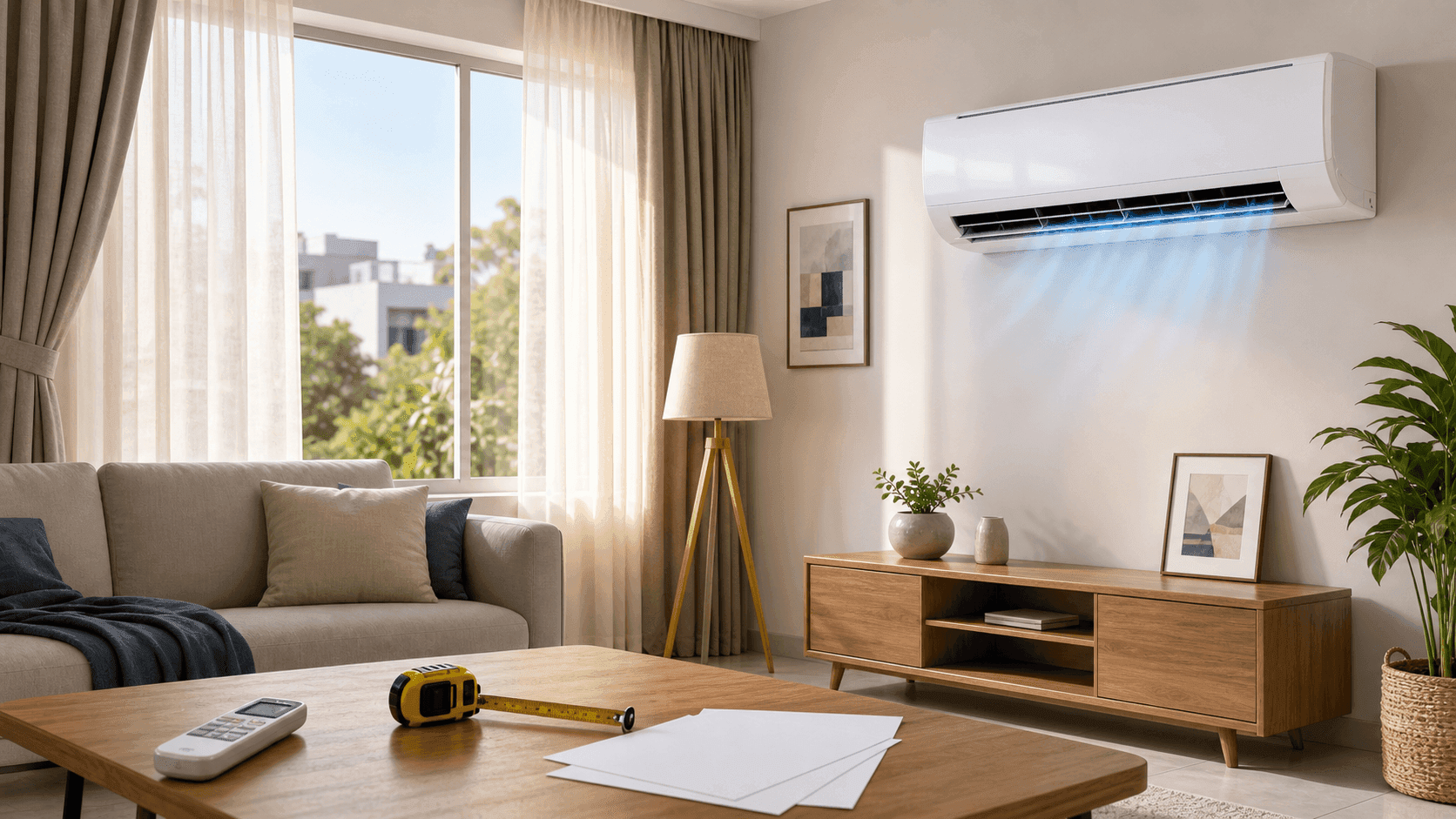
Summer in Pakistan can be brutal. When the temperature hits 40 C and load shedding makes it worse, a good air conditioner is not just a luxury. It is a necessity. But walk into any electronics market in Karachi, Lahore, or Islamabad, and you quickly realize that buying an AC is not as simple as choosing the cheapest unit or the brand your neighbor has.
There is a lot to think about: What type should you get? How powerful does it need to be? Will your electricity bill climb sharply? Is your home's wiring even ready for it?
This guide walks through the practical decisions that matter for Pakistani homes, including AC types, room size, inverter savings, installation safety, and warranty support. By the end, you should know what to look for, what to question, and what to avoid before paying.
If your bigger goal is reducing summer electricity bills, compare AC usage with your home load in the solar system size calculator before choosing a model.
Table of Contents
- Understanding AC Types
- Choosing the Right Cooling Capacity
- Evaluating Energy Efficiency
- Balancing Cost and Value
- Checking Electrical Safety
- Checking Brand Reliability and Warranty
- Conclusion
- What's Next
Understanding AC Types
The first decision is choosing what type of AC to buy. There are four common options available in Pakistan, and each has its own strengths and weaknesses.
Window AC Units
Window ACs are classic all-in-one units that sit in your window or a wall opening. The compressor, cooling coils, and fan are packed into one box.
Pros:
- Affordable upfront cost. Window ACs are usually the cheapest option, making them popular for budget-conscious buyers.
- Easy to install. You usually need only a window opening or wall cavity.
- Simple maintenance. Everything is in one unit, so servicing is straightforward.
Cons:
- Noisy. Since the compressor is inside the room, expect some sound, especially at night.
- Less efficient. They consume more electricity compared with modern split or inverter models.
- Limited cooling power. Most window units max out around 2 tons, so they are not ideal for large rooms.
- Blocks your window. You lose natural light and ventilation.
Best for: Small to medium rooms, rental properties, or anyone on a tight budget who does not mind a bit of noise.
Split AC Units
Split ACs have two parts: an indoor unit mounted on your wall and an outdoor compressor unit installed outside. The two units are connected by pipes that carry refrigerant.
Pros:
- Quieter operation. The noisy compressor sits outside, so the room stays more peaceful.
- Better cooling. Split ACs are more powerful and efficient than window units.
- Aesthetic appeal. The indoor unit looks modern and does not block windows.
- Available in larger capacities. You can find split ACs up to 2.5 tons or more for bigger spaces.
Cons:
- Higher upfront cost. Expect to pay significantly more than a window unit.
- Complex installation. A technician needs to drill holes, mount units, and connect pipes. Installation costs add up.
- More technical maintenance. Servicing split ACs requires more expertise.
Best for: Homeowners who want better cooling, quieter operation, and are comfortable spending more upfront.
Portable AC Units
Portable ACs are standalone units on wheels that you can move from room to room. They vent hot air through a hose that goes out a window.
Pros:
- Mobility. Move it where you need cooling: bedroom at night, living room during the day.
- No permanent installation required. Plug it in and vent the hose.
- Useful for renters. You can take it with you when you move.
Cons:
- Expensive for the performance. Portable ACs often cost as much as split units but cool less effectively.
- Less efficient. They consume more electricity and struggle in Pakistan's extreme heat.
- Takes up floor space. They are bulky and need to stay near a window for venting.
- Noisy. The compressor is in the room with you.
Best for: Renters or people who need temporary cooling in different rooms. For most Pakistani homes, they are a niche option rather than the best value.
Inverter AC Units
An inverter AC is not a separate shape of AC. It is a technology that can be built into split or window units. Traditional ACs turn the compressor on and off repeatedly to maintain temperature. Inverter ACs adjust compressor speed continuously, running at lower power once the room is cool.
Pros:
- Major energy savings. Inverter ACs can reduce electricity consumption by 30-50% compared with non-inverter models.
- More consistent cooling. The room stays comfortable without sharp temperature swings.
- Quieter operation. The compressor does not constantly start and stop.
- Longer compressor life. Less start-stop stress can reduce wear.
Cons:
- Higher upfront cost. Inverter models often cost 20-40% more than non-inverter ACs.
- Repairs can be expensive. Inverter electronics are more complex, so repair bills can be higher.
Best for: Anyone who runs their AC for long hours daily. In many homes, the electricity savings can repay the higher purchase price within a few summers.
Bottom line: If you are on a tight budget and need basic cooling, a window AC can work. If you want comfort, quiet operation, and long-term efficiency, a split inverter AC is usually the better choice.
Choosing the Right Cooling Capacity
Once you decide on the type, the next question is: how powerful should it be?
AC capacity is measured in tons. In Pakistan, the common sizes are 1 ton, 1.5 ton, and 2 ton. Choosing the right capacity is crucial. Too small, and your AC will struggle to cool the room, run constantly, and waste electricity. Too large, and you pay more upfront while the AC cools too quickly without removing humidity properly.
A Simple Tonnage Rule of Thumb
For many Pakistani homes, this is a reasonable starting point:
- 1 ton AC: Around 120-150 square feet
- 1.5 ton AC: Around 150-250 square feet
- 2 ton AC: Around 250-400 square feet
Room size is not the only factor. You also need to consider:
Ceiling height: High ceilings mean more air to cool. If your ceiling is higher than 10 feet, consider going up slightly.
Insulation: Poorly insulated rooms need more cooling power. Large west-facing windows that catch afternoon sun can push you toward a higher capacity.
Number of people: A bedroom with two people needs less cooling than a living room where the whole family gathers.
Heat-generating appliances: A TV, computer, or nearby kitchen adds heat that the AC must remove.
Floor level: Top-floor rooms get hotter because the roof absorbs heat. Ground-floor rooms often stay cooler.
If you are converting measurements or checking room area in different units, BuildQuill's Unit Converter can help you keep the sizing math consistent before you compare models.
Example Calculation
Suppose you have a 200 square foot bedroom on the top floor with a west-facing window. Normally, 200 square feet suggests a 1.5 ton AC. But because the room is on the top floor and catches afternoon sun, a 2 ton unit may be more realistic.
The Danger of Oversizing
Some buyers think "bigger is better" and buy a 2 ton AC for a small room. That can backfire.
An oversized AC cools the room too quickly, then shuts off. It cycles on and off repeatedly, which:
- Wastes electricity because compressor startup uses more power
- Does not remove humidity properly, so the room can feel cold but clammy
- Wears out the compressor faster
The Danger of Undersizing
An undersized AC runs constantly while struggling to reach your target temperature. It may never shut off, the electricity bill rises, and the compressor works harder than it should.
Bottom line: Measure your room, consider sun exposure and insulation, and choose capacity carefully. If a salesperson recommends a size, ask how they calculated it.
Evaluating Energy Efficiency
Now comes the electricity bill.
An AC is usually one of the most power-hungry appliances in the home. In Pakistan, where electricity rates are high and summer lasts for months, an inefficient AC can cost thousands of rupees every month. Efficiency is not a small detail. It is a major buying factor.
Understanding Energy Ratings
AC labels may show EER (Energy Efficiency Ratio) or SEER (Seasonal Energy Efficiency Ratio). These numbers indicate how efficiently the AC converts electricity into cooling.
- Higher rating = more efficient = lower electricity bills
In Pakistan, many ACs have an EER between 2.5 and 3.5. Inverter ACs often rate higher.
As a practical guide:
- EER 2.5-2.9: Basic efficiency, common in older or cheaper units
- EER 3.0-3.4: Good efficiency for standard split ACs
- EER 3.5+: Strong efficiency, often found in inverter and premium models
The Real Cost of Inefficiency
Here is a simplified comparison. Suppose you run an AC 8 hours a day for 6 months, or roughly 180 days.
Scenario 1: Non-inverter 1.5 ton AC with EER 2.8
- Power consumption: about 1,800 watts
- Daily usage: 1.8 kW x 8 hours = 14.4 kWh
- Monthly usage: 14.4 x 30 = 432 kWh
- Monthly cost at Rs. 25/kWh: Rs. 10,800
- 6-month cost: Rs. 64,800
Scenario 2: Inverter 1.5 ton AC with EER 3.8
- Power consumption after initial cooling: about 1,200 watts
- Daily usage: 1.2 kW x 8 hours = 9.6 kWh
- Monthly usage: 9.6 x 30 = 288 kWh
- Monthly cost at Rs. 25/kWh: Rs. 7,200
- 6-month cost: Rs. 43,200
Estimated savings with the inverter AC: Rs. 21,600 per summer
If the inverter AC costs Rs. 30,000 more upfront, it may pay back the difference in less than two summers. The exact result depends on your tariff, usage, room conditions, and model efficiency, but the direction is clear: daily AC users should care deeply about efficiency.
Star Ratings
Some ACs also show star ratings from 1 to 5 stars. More stars generally mean better efficiency. For heavy use, look for at least 3 stars if possible, and consider 4 or 5 stars when the price difference is reasonable.
Inverter vs. Non-Inverter
Inverter ACs are commonly 30-50% more efficient than non-inverter models under typical long-running use. If you run the AC daily for long hours, inverter technology is often worth the higher upfront cost.
Bottom line: Do not judge an AC only by the sticker price. Calculate the total cost including electricity over several summers.
Balancing Cost and Value
When you walk into a shop, you may see ACs ranging from Rs. 40,000 to Rs. 150,000 or more. It is tempting to buy the cheapest option and leave. That can be a false economy.
Upfront Cost vs. Total Cost of Ownership
The total cost of ownership includes:
- Purchase price
- Installation costs, especially for split ACs
- Electricity bills over the AC's lifetime
- Maintenance and repairs
- Resale value if you sell it later
Compare these simplified examples:
Option A: Cheap non-inverter split AC
- Purchase price: Rs. 50,000
- Installation: Rs. 8,000
- Electricity for 6 months a year over 8 years: Rs. 64,800 x 8 = Rs. 518,400
- Maintenance: Rs. 20,000
- Total: Rs. 596,400
Option B: Quality inverter split AC
- Purchase price: Rs. 80,000
- Installation: Rs. 8,000
- Electricity for 6 months a year over 8 years: Rs. 43,200 x 8 = Rs. 345,600
- Maintenance: Rs. 15,000
- Total: Rs. 448,600
In this example, spending Rs. 30,000 more upfront saves roughly Rs. 147,800 over 8 years.
When to Spend More
Spend more on:
- Inverter technology if you use AC daily
- Reputable brands with proper service networks
- Higher capacity when your room genuinely needs it
When to Save Money
You can save by:
- Choosing a window unit for a small room or short-term rental
- Buying during the off-season when demand and prices may be lower
- Skipping unnecessary features such as Wi-Fi controls if you will not use them
Avoid False Economy
Be cautious with:
- Unknown brands with no local service support
- Used ACs unless you know their condition and service history
- The absolute cheapest model from a brand if it sacrifices efficiency, warranty, or parts quality
Bottom line: Think about what the AC will cost over 8-10 years, not just what it costs today.
Checking Electrical Safety
This section is less exciting than comparing brands, but it is critical. An AC draws a lot of power. If your home's electrical system is not ready, you risk:
- Frequent circuit breaker trips
- Voltage fluctuations that damage the AC
- Electrical fires in worst-case situations
- Warranty issues if damage is linked to poor wiring or installation
Check Your Wiring Capacity
Many homes have a mix of 5 amp and 15 amp circuits. Your AC should generally have a dedicated 15 amp circuit with proper wiring.
Verify these points:
Wire gauge: The wire should be suitable for the AC's load. For many 1-1.5 ton installations, 2.5 mm2 wiring may be used; larger units may need heavier wiring. Ask a qualified electrician to confirm.
Dedicated circuit: The AC should have its own breaker rather than sharing a circuit with a fridge, TV, water pump, or other heavy appliance.
Circuit breaker rating: Use a properly rated breaker from a reliable brand. Cheap breakers may fail when you need protection most.
If you are not sure about the wiring, hire a qualified electrician before installation. A small inspection cost is better than damaging an expensive AC or creating a safety risk.
Voltage Stability
Pakistan's power supply can be unstable in many areas. Brownouts, surges, and voltage swings can damage the compressor or electronics.
Consider:
Voltage stabilizer: A good stabilizer protects the AC from voltage swings. Choose one rated for your AC's load.
Built-in protection: Some inverter ACs advertise wide voltage operation, but external protection may still be wise in areas with frequent voltage problems.
Proper Grounding
Your AC must be properly grounded. Grounding protects users from electric shock if a fault develops.
Check that:
- The outlet has live, neutral, and ground
- The ground wire is actually connected to a proper earth system
- An electrician verifies grounding with a tester or multimeter
Improper grounding is common and dangerous. Treat it as a safety requirement, not an optional upgrade.
Load Shedding Considerations
Frequent power cuts and sudden restarts can stress an AC compressor.
Helpful protections include:
- Time-delay relay: Prevents immediate restart after power returns, giving the compressor time to stabilize.
- Proper generator or UPS sizing: If you plan to run the AC during outages, make sure the backup system can handle the startup and running load.
Installation Matters
Even if your wiring is good, poor installation can reduce performance and damage the unit.
Insist on:
- Professional installation by trained technicians
- Outdoor unit placement that is shaded, ventilated, and secure
- Correct refrigerant charging
- Properly sealed pipe connections
- Clean drainage with no leaks into walls or ceilings
Most brands offer installation, but do not accept rushed or careless work. A badly installed AC can perform poorly from day one.
Bottom line: Spend a little extra on safe wiring, grounding, voltage protection, and proper installation. Your AC and your family's safety depend on it.
Checking Brand Reliability and Warranty
After type, capacity, efficiency, cost, and electrical readiness, the final decision is brand.
In Pakistan, you will find local, imported, well-known, and obscure AC brands. The right choice is not only about cooling performance. It is also about service support.
Why Brand Matters
An AC is a long-term purchase. Over 8-10 years, you may need:
- Warranty support
- Spare parts
- Technicians who understand the model
- Seasonal maintenance
A cheap AC from an unknown brand may save money today, but if it breaks in peak summer and there is no service center in your city, the saving disappears quickly.
Common Brand Categories in Pakistan
Japanese and Korean brands: Daikin, Mitsubishi, LG, Samsung
- Premium quality and strong efficiency
- Higher prices
- Service availability varies by city and model
Reputable Chinese brands: Haier, Gree, TCL, Hisense
- Often good value for money
- Improving service networks
- Quality can vary by model range
Local or locally assembled brands: Dawlance, Waves, Orient
- Budget-friendly and widely available
- Service access can be easier in many cities
- Model quality varies, so compare carefully
Avoid obscure brands with no visible service network, no official contact details, or consistently poor customer reviews.
What to Look for in a Warranty
Check these warranty details before buying:
Compressor warranty: Look for at least 5 years when possible. The compressor is the heart of the AC and expensive to replace.
Parts warranty: Other components should ideally have at least 1-2 years of coverage.
Labor warranty: Some warranties cover parts but not labor. Ask clearly before purchasing.
Conditions: Warranties may exclude damage from voltage fluctuations, poor installation, lack of maintenance, or physical damage.
Registration: Some brands require warranty registration within a set number of days. Do not miss this step.
Service Network
Before paying, ask:
- Where is the nearest service center?
- What is the compressor warranty period?
- Are labor charges covered during warranty?
- How long does a typical service call take in summer?
- Are spare parts available locally?
- Can you see the warranty card before purchase?
Customer reviews can also reveal patterns. One bad review is normal. Repeated complaints about service delays, unavailable parts, or ignored warranty claims are warning signs.
Annual Maintenance
Most ACs need servicing once or twice a year, usually before and after the heavy summer season.
Routine service includes:
- Cleaning filters and coils
- Checking refrigerant levels
- Inspecting electrical connections
- Testing cooling performance
Some brands or service providers offer annual maintenance contracts. These can be useful if you prefer scheduled servicing rather than waiting until the AC performs badly.
Bottom line: A reliable brand with responsive service support is worth paying extra for. When your AC stops cooling in July, warranty and technician availability matter more than showroom promises.
Conclusion
Buying an AC in Pakistan does not have to be overwhelming. If you work through the decisions in order, you can avoid the most expensive mistakes.
Here is the recap:
- Choose the right type: Split inverter ACs offer the best balance of comfort, efficiency, and long-term value for many homes.
- Size it correctly: Measure your room, consider insulation and sun exposure, and avoid both oversizing and undersizing.
- Prioritize efficiency: Inverter ACs cost more upfront but can save thousands in electricity bills.
- Think long-term: Calculate total ownership cost, not just the purchase price.
- Check electrical safety: Verify wiring, grounding, voltage protection, and installation quality.
- Choose a reliable brand: Service network, spare parts, and warranty terms matter.
Take your time. Visit multiple shops. Ask questions. Do not let salespeople pressure you into buying the same day. A good AC should serve you through many Pakistani summers, so it is worth choosing carefully.
What's Next
Before you visit the market, measure the room, note sun exposure, check the breaker and wiring, and list your expected daily AC usage. Then compare two or three models by total cost, not only by price tag. That small preparation makes the salesperson's advice easier to verify and keeps the final decision grounded in your actual home.
Final check
Conclusion
- A practical AC buying guide for Pakistani homes covering split, window and inverter models, room sizing, electricity costs, wiring safety and warranty support.
- Summer in Pakistan can be brutal. When the temperature hits 40 C and load shedding makes it worse, a good air conditioner is not just a luxury. It is a necessity.
- This guide walks through the practical decisions that matter for Pakistani homes, including AC types, room size, inverter savings, installation safety, and warranty support.
Quick answers
Frequently asked questions
When to Spend More?
Spend more on: Inverter technology if you use AC daily Reputable brands with proper service networks Higher capacity when your room genuinely needs it
When to Save Money?
You can save by: Choosing a window unit for a small room or short-term rental Buying during the off-season when demand and prices may be lower Skipping unnecessary features such as Wi-Fi controls if you will not use them
Why Brand Matters?
An AC is a long-term purchase. Over 8-10 years, you may need: Warranty support Spare parts Technicians who understand the model Seasonal maintenance A cheap AC from an unknown brand may save money today, but if it breaks in peak summer and there is no service center in your...
What to Look for in a Warranty?
Check these warranty details before buying: Compressor warranty: Look for at least 5 years when possible. The compressor is the heart of the AC and expensive to replace. Parts warranty: Other components should ideally have at least 1-2 years of coverage.
What's Next?
Before you visit the market, measure the room, note sun exposure, check the breaker and wiring, and list your expected daily AC usage. Then compare two or three models by total cost, not only by price tag.
Use a related tool
Run an estimate, then confirm serious decisions with qualified professionals.